ConceptAI product design
Mission control that thinks ahead.
Perigee is a concept for satellite operators: an AI copilot that screens tens of thousands of objects, ranks what needs a person, drafts the options and never commands a burn on its own. It is how I would design an AI product where the stakes are real.
- Client
- PerigeeSelf-initiated concept
- Industry
- AI productSatellite operations
- Role
- Product designerProduct, AI interaction, UI
- Year
- 2026Seven screens and a system











Perigee
Scroll to bring the panels in
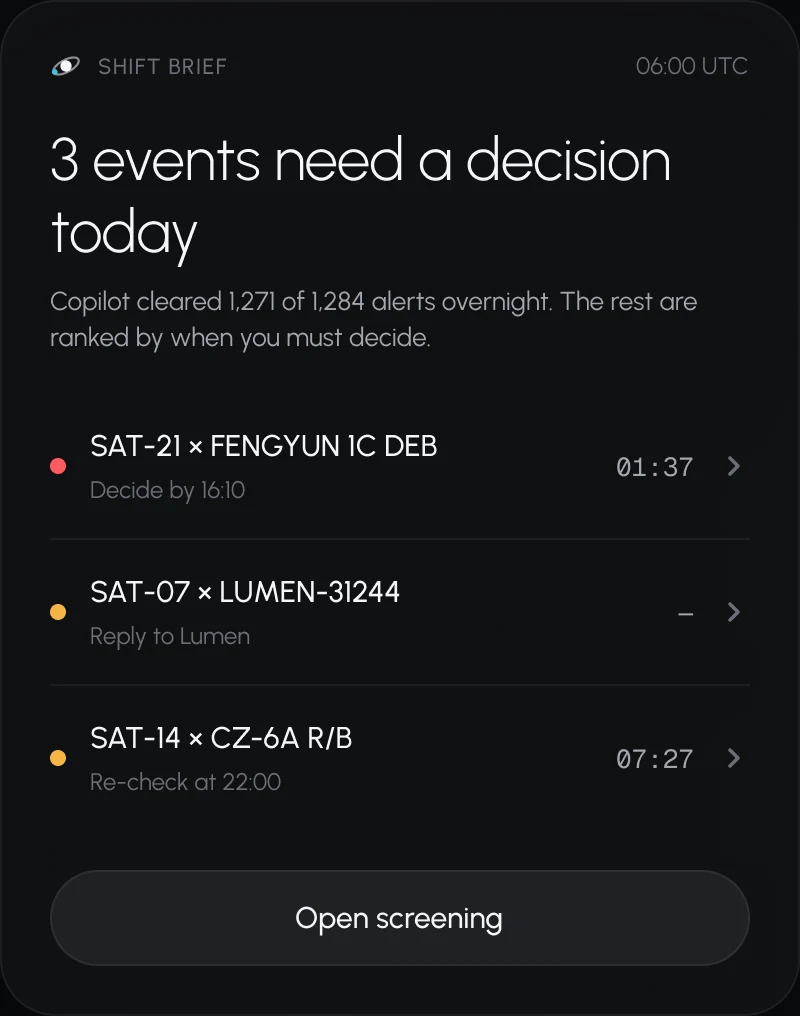
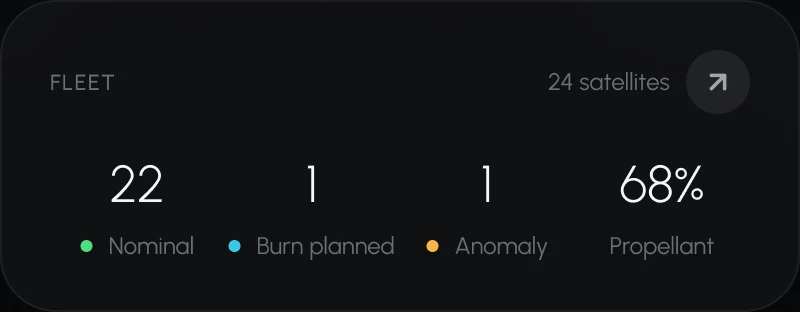
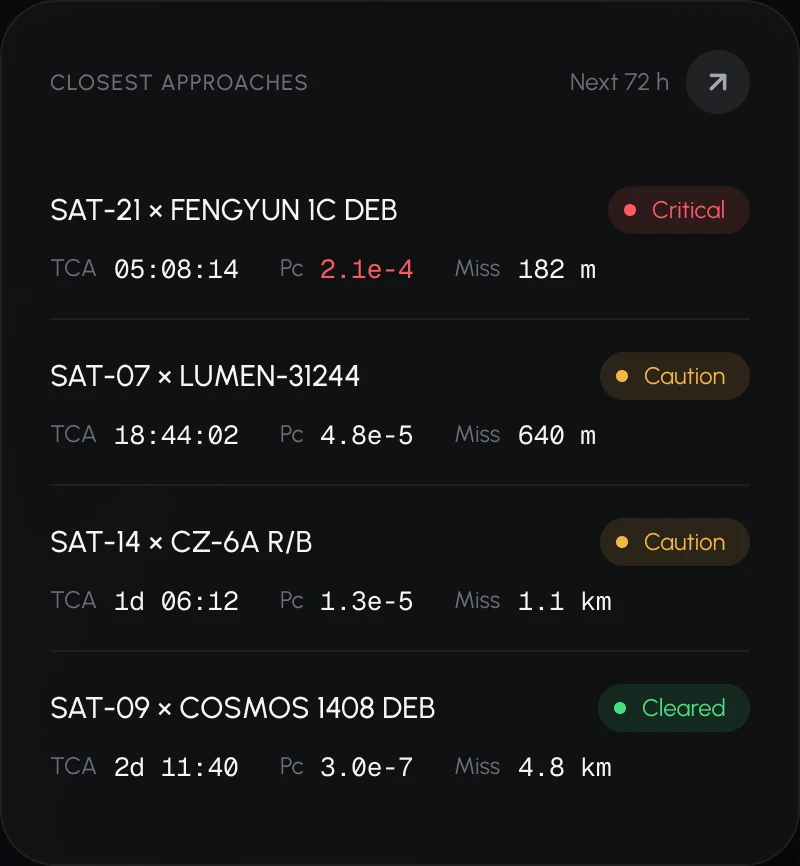
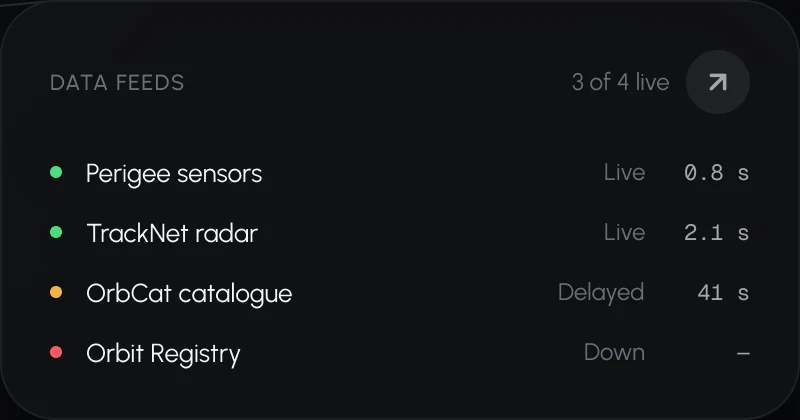
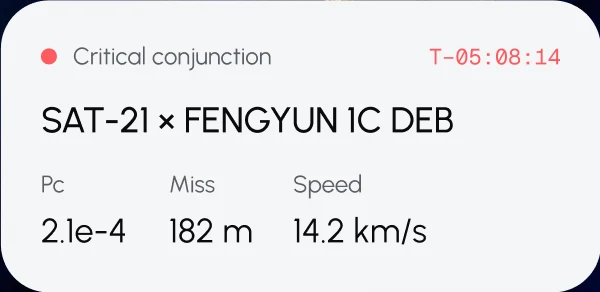
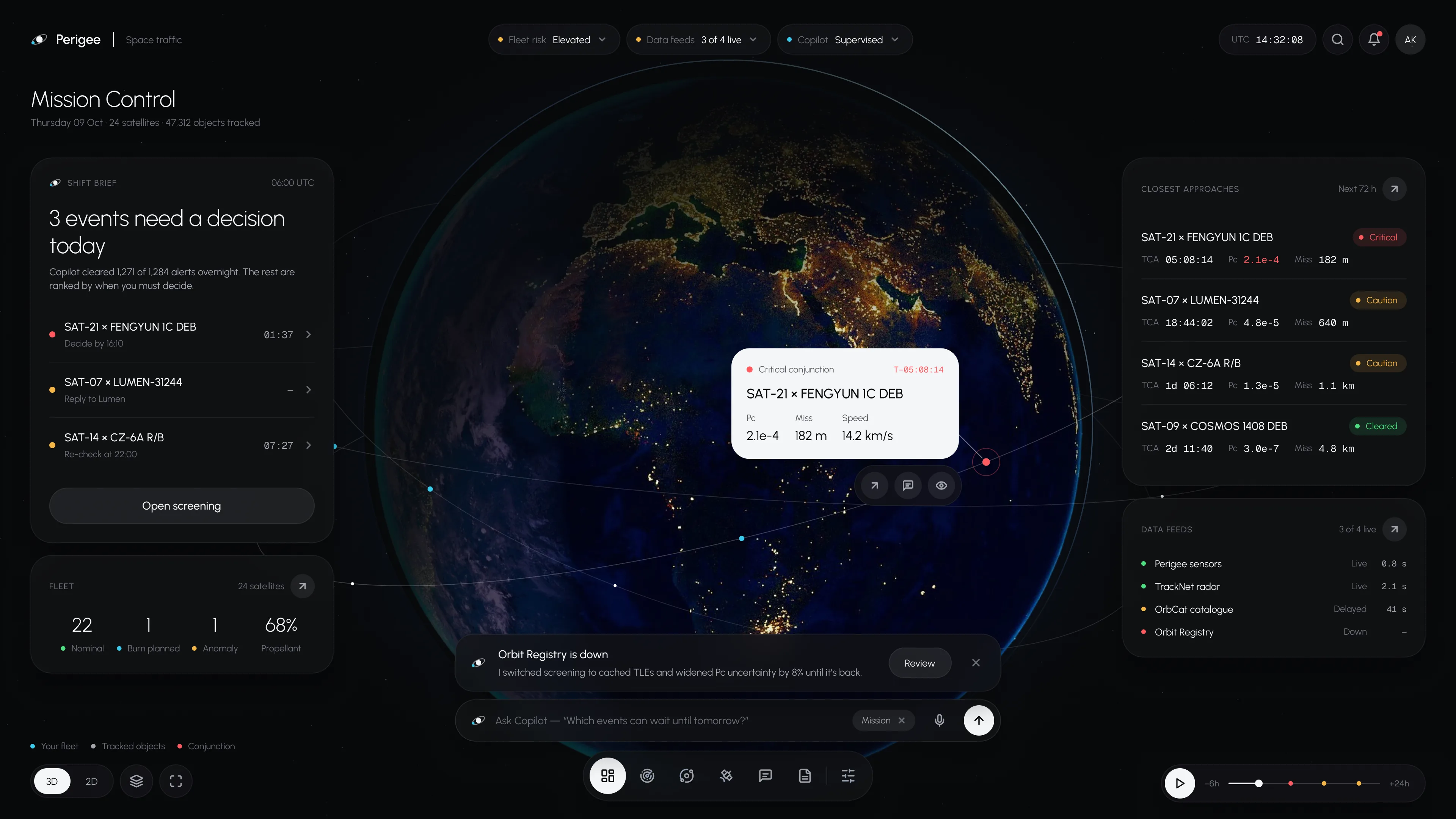
T+00:00 · Mission Control, docked: the shift brief, the closest approaches and Copilot, around a live globe
The brief
Space traffic isn't a data problem. It's an attention problem.
A satellite operator's day is a stream of conjunction warnings: messages that say two objects will pass close at a given time, with a probability of collision. Almost all of them need nothing. A few need a burn, planned and approved within hours, while the data that decides it is still arriving from feeds of different ages.
Perigee is a concept for that job. Its copilot does the reading, the ranking and the drafting; the operator does the deciding. It started as a design challenge in 2024 and became a full concept in 2026.
One shift, narrowed
Flight rules
An AI you can fly with, not just ask.
The interesting design work in an AI product is not the chat box. It is deciding what the AI may do alone, how it shows its working, and how it hands a decision back to a person. These are the rules Perigee is built on, each shown where it lives.
Flight rules · 01 of 08
Triage before you alert.
Copilot reads every overnight alert and leaves three, ranked by when a decision is due. The operator starts the shift with a brief, not a backlog.
The product
Seven screens for one shift.
From the morning brief to the weekly report: screening an event, designing the burn, watching the fleet, agreeing with another operator in a shared room, and setting the rules Copilot works within.
Seven screens in orbit
The whole product, one shift deep.
The system
Quiet by default, loud only when it matters.
A near-black canvas, glass panels and one typeface keep a dense screen calm. Colour is held back for meaning, and every number an operator acts on is set in mono so it can be read at a glance. Here is a slice of the system, running.
Tokens
- Canvas#07080a · bg/canvas
- Panel#131417 · bg/panel · 72% glass
- Text 1#f5f6f8 · text/1
- Text 2#a3a6ae · text/2
- Text 3#6c6f78 · text/3
- Cyan#38c9ed · Copilot, your fleet
- Blue#5196fb · accent/blue
- Violet#7944f9 · accent/violet
- Critical#ff5a5f · act now
- Caution#f5b544 · watch, coordinate
- Safe#4ade80 · cleared, kept
Three radii carry the whole UI: pills at 999, tiles at 16, cards at 28. Colour is kept for meaning: cyan is Copilot and your own fleet, and red, amber and green only ever mean risk.
Components, live
What I'd test next
A concept is a hypothesis. Here is the flight test.
Nothing here has met an operator yet, so the next step is not polish but evidence. These are the five questions I would put in front of real operators first, how, and what would count as a pass.
- Test 01Not yet flown
Is a ranked brief faster than an alert list?
- How
- A simulated shift: twelve operators, forty synthetic conjunction messages, half of them starting from the brief.
- It passes if
- Decisions come sooner and no event that needed a burn is missed.
- Test 02Not yet flown
Will operators trust what Copilot cleared?
- How
- A blind spot-check: a mix of cleared and uncleared alerts, reviewed without labels, then a week of real use.
- It passes if
- Operators rarely disagree with the clears, and spot-checking tapers off rather than disappearing.
- Test 03Not yet flown
How should confidence be shown?
- How
- The same recommendation shown three ways: a percentage, a band, and plain words.
- It passes if
- Operators act on high confidence and pause on low, instead of treating every number alike.
- Test 04Not yet flown
Do side-by-side options lead to better burns?
- How
- Option tables against a single recommendation, on the same events.
- It passes if
- Approvals come no slower, and the chosen burns spend less propellant for the same safety.
- Test 05Not yet flown
Will another operator use a room instead of email?
- How
- A four-week pilot with two operators who already coordinate.
- It passes if
- Most new coordinations start in a room, and agreements are locked sooner than by email.
Everything here is fictional
- Perigee
- the product
- Aster
- the satellite operator using it
- Lumen · Meridian
- other operators
- Orbit Registry
- a public conjunction service
- TrackNet · OrbCat
- tracking data sources
- Orbital Safety Office
- the regulator receiving reports
Debris names such as FENGYUN 1C DEB are real public catalogue objects, used for realism. Every value is illustrative.
Next case study
Rebuilding Shikhar's order flow around how a shopkeeper actually buys
Read it
Facing a similar problem?
Start a project